
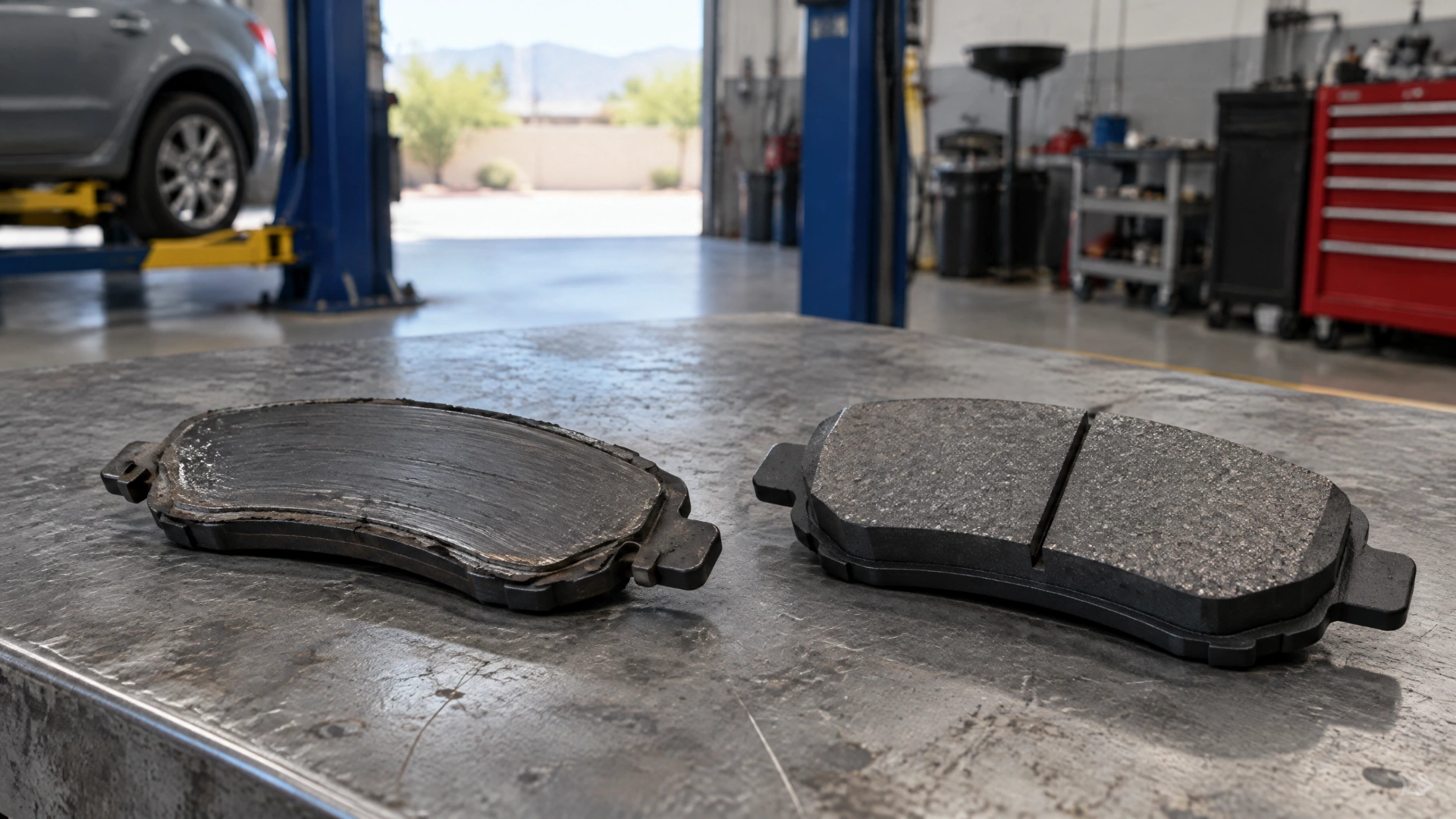
Brakes don’t wear out from distance. They wear out from heat. Every time you slow down, the car’s momentum has to go somewhere, and it goes into the pads and rotors as heat that then has to shed into the air. That’s the whole job.
Which is why the drive down from Flagstaff isn’t what kills brakes here. Stop-and-go on the 51 in August is.
How brakes actually wear
The pad is a block of friction material pressed against a spinning iron disc. Each stop shaves a little material off the pad and puts a lot of energy into the rotor. The rotor’s job is to soak up that heat and then dump it into the air moving across it.
That last part is what people miss. A rotor cools by having air pass over it. When the car is moving, that happens. When you’re sitting at a light on Bell Road with 110-degree air and hot asphalt underneath you, it doesn’t.
Why the 51 at five o’clock is worse than a mountain descent
Coming down a grade, you’re braking gently and more or less continuously, and you’re doing it at speed — so there’s constant airflow over the rotors. The heat goes in steadily and comes out steadily. It’s work, but it’s balanced.
City traffic in summer is the opposite. Each stop is a short burst of high energy, and then you sit still with no airflow while the heat soaks through the rotor and into the pad, the caliper and the fluid. Then you do it again forty seconds later. The heat never fully leaves between stops, so it stacks.
Add ambient heat that’s already extreme and pavement radiating back up at the underside of the car, and a commute that looks gentle on paper is harder on a brake system than a mountain road.
What that heat does to the rotor
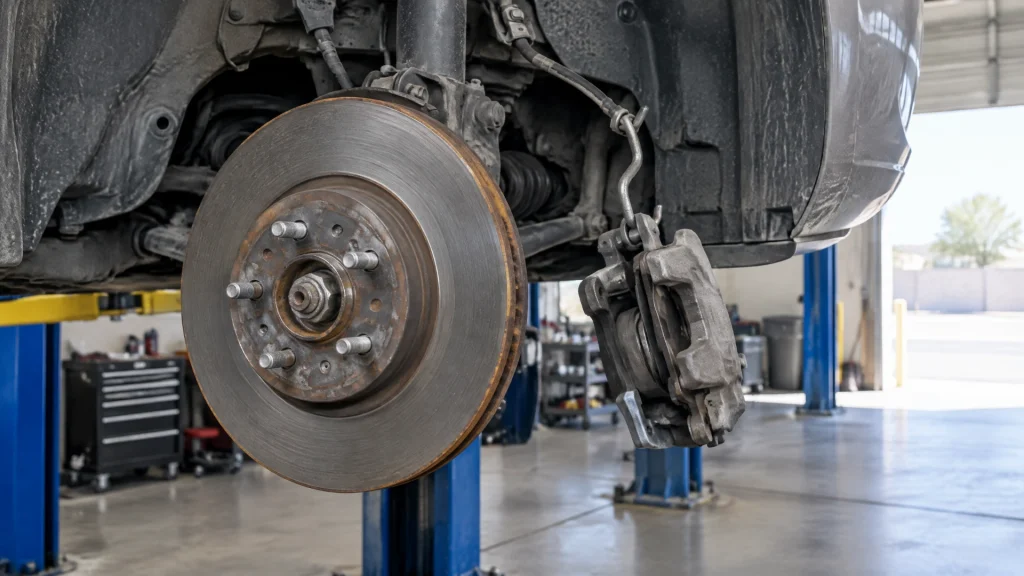
Iron that gets repeatedly overheated doesn’t wear evenly. You get hot spots where the material changes and hard patches form, and the disc stops being perfectly flat — it goes out of round. That’s what you feel as a pulsation through the pedal or a shimmy in the wheel when you brake from highway speed. A shimmy that’s there all the time, not only under braking, is usually balance or alignment, or something in the suspension — not the brakes.
People bring that in thinking it’s a warped rotor. Mostly it isn’t warped in the way that word suggests. It’s uneven material and thickness variation from heat, and it produces the same symptom.
The same heat hardens the pad’s friction surface, which is why brakes that have been cooked often squeal and bite worse even with material left on them.
Brake fluid, and why the dry air doesn’t save you
Brake fluid absorbs moisture out of the air over time. Moisture lowers the temperature at which the fluid boils, and boiling fluid puts gas in a system that only works because liquid doesn’t compress. That’s the long pedal people describe after a hard stretch of driving.
Low humidity here slows the absorption down a little. It does not stop it — the fluid pulls moisture through the reservoir cap and the flexible lines regardless, and our heat pushes the fluid closer to its boiling point in the first place. So the margin you’re protecting matters more here, not less.
Most manufacturers put brake fluid on a time interval rather than a mileage one, which tells you how they think about it. It’s the service almost everybody skips.
What I’d tell you to leave alone
Not every brake noise is a brake problem, and I’d rather say that than sell you something.
A light squeak in the morning, especially after a humid night or a car wash, is usually surface rust flashing off the rotor. It goes away in the first few stops. That’s not a repair.
Brake dust on the front wheels is normal, and more of it on a European car is very normal — those pads are formulated differently.
And if somebody tells you rotors always get replaced with pads, ask them what the rotors measured. Rotors have a minimum thickness stamped on them and a runout spec. Sometimes they’re past it and they need replacing. Sometimes they measure fine and they don’t. The difference is a measurement, not a policy.
What we actually do when you bring it in
The wheels come off — you can’t assess brakes through a wheel, whatever anyone tells you. That’s what a brake inspection is, and we don’t charge for it. We measure the remaining pad material and compare it side to side, because uneven wear front to back or left to right usually means a caliper or a slide pin, not a pad problem.
Then the rotor gets measured for thickness and for runout, so the resurface-or-replace question gets an answer instead of an opinion. We look at the flexible lines, the hardware and the fluid.
You get photos of all of it. I’d rather show you a picture of your own pad next to a new one than describe it to you.
Frequently asked questions
How long should brakes last in Phoenix?
There’s no honest single number, because it depends almost entirely on where you drive. A car that spends its life in stop-and-go traffic in summer heat can go through pads in a fraction of the time a highway commuter does on the same mileage. Judge it by measurement, not by odometer.
My brakes shudder at highway speed. Is that dangerous?
It’s usually thickness variation in the rotor rather than something about to fail, but it’s a symptom worth getting measured rather than ignoring — and it tends to get worse, not better, because the uneven surface generates more uneven heat.
Do I need new rotors every time I need pads?
No. Sometimes yes, sometimes no, and the way to know is to measure them against the minimum thickness spec. Anyone answering that question without a micrometer is guessing.
When should brake fluid be changed?
Check what your manufacturer specifies — most put it on a time interval, commonly every two to three years. In this climate I wouldn’t stretch it past what the book says.
Can heat damage brakes even if I don’t brake hard?
Yes, and that’s the part that surprises people. Repeated moderate stops with no cooling time between them, in extreme ambient heat, put more thermal load on the system than occasional hard braking at speed.
If something doesn’t feel right, come see us
Bring it in and we’ll pull the wheels, measure what’s there and show you the photos. If the brakes are fine, we’ll tell you they’re fine — that happens more often than you’d think.
Jimmy G’s Automotive — North Phoenix
17217 N Tatum Blvd, Phoenix, AZ 85032
(480) 599-5111
Jimmy G’s Automotive — Peoria
8615 W Kelton Ln, Suite 306, Peoria, AZ 85382
(480) 932-3565
Mon–Fri 7:30 AM – 5:00 PM · Sat 7:30 AM – 4:00 PM · Sun closed